

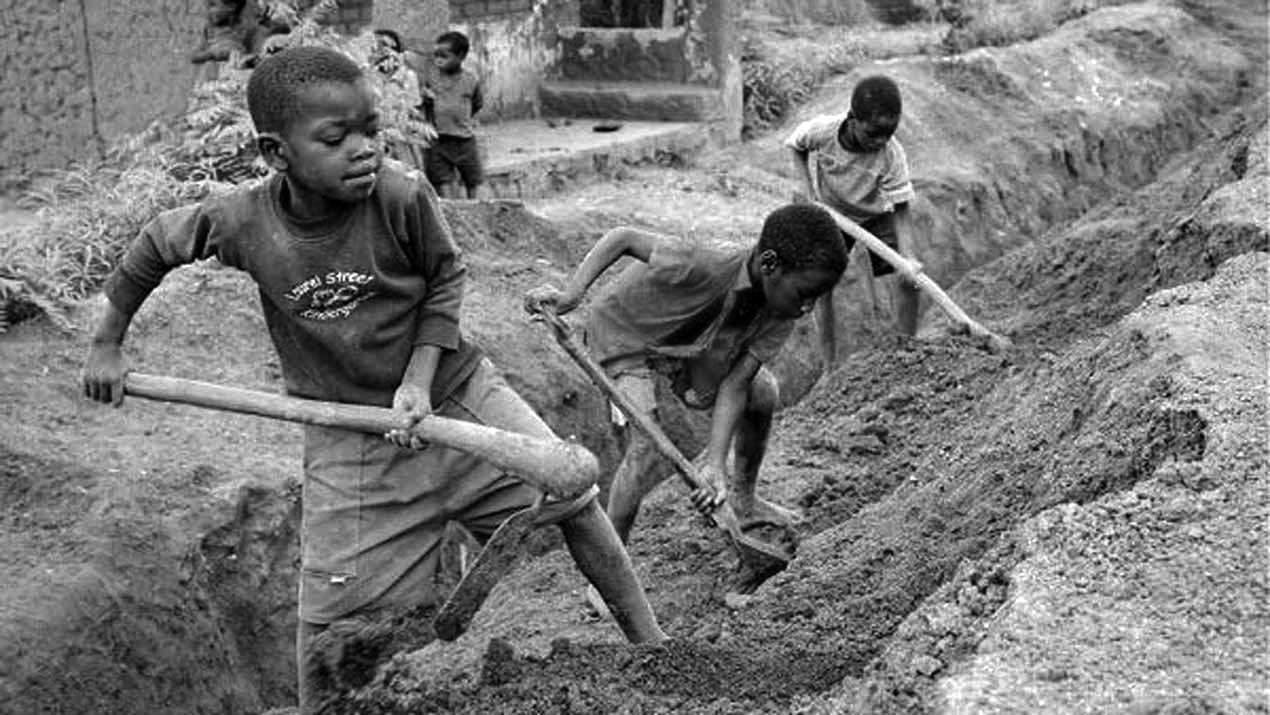
In Capital, Marx refers to children employed in match production and chimney sweeping precisely because of their small hands and bodies. The exploitation of children’s labor power and the accumulation derived from it have been part of the capitalist production system since the very beginning. Child labour is one of the most fundamental dynamics of the capitalist system and its relations of production.
The existence of child laborers is a reality that, despite its extent, is rarely addressed, is often excluded from statistical accounts, and appears in official statistics only every five to ten years.
Yet, child labour is one of the most significant problem areas of our time. Fighting it and ensuring its eradication is only possible if we identify the structural causes that produce it.
This Reality Is Not New
The employment of children certainly did not begin with capitalism, but the capitalist system saw the formation of an “army of child workers” who are employed under harsh conditions, for long hours, with low wages, and without security. This is because the cost of child labour power for capital is much lower. Furthermore, children are easier to dominate. Here, it is important not to forget that education policies are also one of the factors that feed the cycle of child labour exploitation. As children become workers, poverty continues for generations. Within this system, children are drawn into the cycle of never-ending labour at a very early age.
With the globalization of capitalism, child labor, which has spread to every corner of the world, has taken on an even more brutal form in today’s environment of structural crisis.
The crisis of capitalism, combined with the pandemic, is driving capitalists even more towards cheap labour than in previous periods. It is precisely through this method that the number of the poor is growing like an avalanche, while the number of the world’s wealth elite is multiplying. Such periods, like wars, disasters, and epidemics, lead to an increase in child workers. Besides, what employer wouldn’t prefer “docile” child workers who will do the same job as an adult, but for less money and without requiring security?
Globally, a total of 160 million children (63 million girls and 97 million boys) or one in every ten children, are currently working as child labourers. Nearly half of these children, a population of 79 million, are working in hazardous jobs that affect their health and development. The report prepared by the International Labour Organization (ILO) and UNICEF confirms this.
“According to the report released by the International Labour Organization (ILO) and UNICEF on June 10, 2021, the number of children in child labour has risen to 160 million worldwide, an increase of 8.4 million over the last four years; an additional 9 million children are at risk due to the impacts of the COVID-19 pandemic. The report highlights a significant increase in the number of child labourers aged 5 to 11 years, who now account for more than half of the total number of child labourers globally. The number of children aged 5 to 17 years in hazardous work, defined as work that is likely to harm their health, safety, or morals, has risen by 6.5 million since 2016 to 79 million.”
Looking at the regional distribution of child labour, Africa has the highest figures, both as a percentage and in absolute numbers, with 92 million children, representing one in every five children. The Asia-Pacific region comes second: 49 million children, or 5.6% of all children. The remaining child labour population is distributed among other regions: the Americas, 8.3 million; Europe and Central Asia, 8.3 million, and the Arab States, 2.4 million. In terms of sectoral distribution of child labour, agriculture holds the largest share by a wide margin; 70% of the world’s child labourers and 112 million in absolute numbers. 31.4 million children work in the service sector, and 16.5 million in the industry sector. Children aged 5 to 11 constitute the largest part of child laborers, and also a large part of those working in hazardous jobs. 48% of child labourers are in the 5-11 age group, 28% in the 12-14 age group, and 25% in the 15-17 age group.
According to the ILO report, the largest sector widely using child labour under poor conditions is the coffee industry. Colombia, Kenya, Uganda, Mexico, and Honduras are among the leading countries where this work is carried out. Here, children are employed to pick coffee beans.
Only two years ago, it was revealed that Starbucks and Nestlé’s Nespresso were employing children under the age of 13 on coffee farms in Guatemala. Some of these children were under 8 years old. They worked 8 hours a day and were paid per kilogram of beans they collected. For those who didn’t see the news: the wage the children received for one day was not even the price of a single latte sold in our country.
Outside of this sector, there are millions of children globally working in agriculture, especially in cotton fields. Some countries in Africa, along with countries like Uzbekistan and Turkmenistan, are prominent in this. Here, too, children are paid per kilogram of cotton they pick.
In mines, brick and nail factories, and transitioning from agriculture to industry, construction, and the service sector, child laborers are among capital’s most important sources of surplus value. What Marx stated in Capital remains the starkest reality: “The bourgeoisie creates capital from the blood of children.”
Are Programmes of Struggle Effective?
The ILO announced that the target for the elimination of child labour is 2025. However, considering the poverty that has multiplied with the pandemic and the deepening gap between the rich and the poor, it is obvious that this will not go beyond a “rosy” dream. Millions of children who could not access education in the past year have already been swept into the cogs of capital. Furthermore, since the capital powers of the states that claim they will fight child labour are precisely those who employ child laborers, it is not difficult to guess that these will remain mere rhetoric. The clean clothes, accessories, and jewels that adorn the shop windows of glittering European stores exist through the exploitation of labour power in poor countries by developed capitalist nations. In every commodity here, there is the labour and blood of children.
In the historical course of capitalism, law has an important role in the stage of rationalizing the market and production. One of the functions of the legal structure (codification, laws, regulations, guides) in this process is to protect social reproduction and capitalist relations of production by disciplining the workplace and labour power. Normalizing “truly horrifying” conditions of exploitation is included in the fulfillment of all these functions.
Therefore, the implementation of laws and conventions enacted and signed to prevent the exploitation of child labour would mean that those who wrote and signed those agreements are cutting the branch they are sitting on. Yet, capitalism has been oriented towards child labour from the very beginning.
In Capital, Marx refers to children employed in match production and chimney sweeping precisely because of their small hands and bodies. The exploitation of children’s labor power and the accumulation derived from it have been part of the capitalist production system since the very beginning. Child labour is one of the most fundamental dynamics of the capitalist system and its relations of production.
From this perspective, we can observe that many of the laws and regulations created in response to these figures prove ineffective when the interests of capital are at stake. A similar situation applies to the fight against child labour: the ILO may issue annual declarations promising to end child labor and publish pages of action plans, yet the number of child laborers continues to increase at an accelerating pace.
As Poverty Increases, So Do Child Laborers
There are many reasons for the increase in child labour, but one of the most fundamental reasons is poverty. But we cannot address poverty in isolation. We need to see the structural reasons that create poverty. Seeing this affects our perspective on poverty and child labour, and our methods of struggling against them.
Capitalism is a system that constantly produces poverty; thus, it is a problem inherent in the system. Poverty is permanent in capitalism. Crises that the system enters, especially economic crises, increase poverty; income distribution is disrupted, and the problem of distribution deepens. Of course, poverty exists even when there are no crises, but crises deepen it further. The system constantly reproduces this poverty. This is a fundamental problem that cannot be solved with social security or aid packages. Because it exists in conjunction with its opposite: wealth. As wealth increases, poverty deepens.
In summary, in this environment of poverty, to defend the interests of children and to produce policies regarding them, we must point to the root of the problem and see those internal connections. Because the same poverty is a matter directly linked to income distribution, taxes, and the budget. In capitalism, incomes and wealth are unequally divided. This unequal distribution has deepened with neo-liberal policies and continues to deepen.
Within this framework, turning the lens towards Turkey will now be more meaningful.
Turkey: “A Heaven for Cheap Labour!”
Turkey has long been transformed into a “heaven for cheap labour” for capitalism. Everyone who gets rich through this labour, from chambers of commerce to the government, openly voices this. Calls are even made to European investors: Come and establish factories here, our labour is cheap, and the minimum wage is low. This existing situation has further whetted the appetite of capital that gained strength during the pandemic; capitalism, which has long been unable to overcome its structural crisis, seized the opportunity of the pandemic to increase exploitation. The state, at this point, provided all the necessary support for the employers. Cheap, flexible, and insecure employment became even more widespread.
As inflation rose, purchasing power fell, and wages melted away right at the supermarket door. Poverty turned into a relentlessly burning fireball in the middle of the country. Yes, this fireball falls into every home and causes real pain. On the other hand, there is the reality that the existence of capitalism produces unemployment. Under these conditions, when more than ten million people in our country are unemployed, the number of those who will take “any job available” and those who are forced to work for “better than nothing” wages has grown.
This entire process of impoverishment, low income, and lives on the brink of starvation directly affects child labour. According to the “TÜİK, Child Labour Force Survey Results, 2019” report, around 720,000 children were working in the country, primarily in agriculture. We do not have precise data other than official sources, but if we consider that these numbers have a seasonal effect (especially a prominent variable in agriculture), that unregistered workers are not included in this data, and that in recent years, especially refugee children who have migrated from Syria or Uzbekistan—and are mostly unregistered in the population—are working, we can say that this figure is actually at least twice the announced number.
According to the ISIG Assembly occupational homicides reports:
- TÜİK data (720 thousand people) obscures the real dimensions of child labour. Key components of child labour, including apprentices, interns, and vocational training students, whose numbers reach 1.5 million, are missing from the statistics used to support the claim that child labour has decreased. Furthermore, child labour force surveys are conducted not in the summer months, but seasonally in Turkey during October and December, when child labour is at its lowest, which conceals the true extent of child labour.
- We have identified 9 children who died while working at the ages of 4 and 5. This implies that child labour begins at these ages. The fact that “no working children aged 5 were observed” despite deaths in this age group leads us to question the scope of these surveys once again.
- 65.7% of child worker deaths belong to the 15-17 age group, while this rate is 34.3% for those aged 14 and under.
- Ignoring the 1.5 million children who are apprentices, interns, and vocational training students, as mentioned in the first point, also overshadows the information given about education. The 4+4+4 education system created a significant momentum in this process. According to the Eğitim-Sen prepared “Survey on the Impact of Conflicts on Education-Training and Teachers,” while there were only 45 private vocational high schools in Turkey during the 2011-2012 academic year when this application was initiated, as a result of direct support and incentives with public resources in the last three years, the number of schools has shown an astronomical increase of approximately 10 times, and the number of students attending private vocational high schools has increased by 17.5 times. We should also mention that the MEB (Ministry of National Education) announced the number of children it identified as working when they should be at school but “could not reach” as approximately 440,000.
- 57.3% of the children who died in occupational homicides were working in agriculture, 19.5% in industry, 12.8% in services, and 10.4% in the construction sector.
- 77.4% of the children who died in occupational homicides were paid employees or daily wage earners, and 32.6% were unpaid family workers/self-employed (20% farmers and 12.6% artisans).
As poverty and unemployment increase, and purchasing power and household income decrease, the number of children forced to work increases. This poverty resembles a vortex that pulls children in the most!
The cause of poverty is, of course, capitalist production and distribution relations. Within this system, the children of workers and labourers are forced or directed to work more as the income entering the household decreases. This becomes a necessity for them. In fact, in surveys conducted with child workers, children mostly say they are working “to support the family.” Capital, in turn, increasingly prefers cheap and “docile” labour power. As a result, child labour is multiplying.
Perhaps the issue will be understood more clearly if we look at it this way: Which children are forced to work? Which children die while working? Which children go to school hungry?
The children of workers, labourers, and the people. It is impossible to see the child of an employer in the industry or on the farm!
Wars, migrations, and disasters are at least as direct an influence on the proletarianization of children as the economic crisis. Especially the children of families who become workers and increasingly poor as a result of rural-to-urban migration are forced to work in heavy jobs at a young age, at best while still in high school. Until a few years ago in Turkey, especially the children of poor Kurdish families in the cities were forced to work.
Now, refugee children have been added to this group. Many refugee children who do not even have official registration documents work on the streets, in factories, or in workshops. These children usually have no security. There is also no legal framework to hold anyone accountable if something happens to them. In other words, refugee children are at the very bottom of this vast pyramid.
The number of Syrian and Afghan refugees living in Turkey due to incorrect foreign and domestic policies, along with unregistered migrants and refugees, is estimated to be around six million. Migrant and refugee children, who constitute a significant portion of this population, are included in the labour market in sectors such as agriculture, industry, construction, and trade, on a daily and insecure basis. For employers, this means an additional mass of child workers with whom there is no possibility of wage bargaining, whose wage payments can be short or delayed, who can be subjected to violence when they seek their rights, and who can be forced to work.
What Kind of Work Are These Children Doing?
It would be appropriate to start by discussing the children of seasonal agricultural workers. With poor families leaving their homes in Kurdish provinces in the spring to come to agricultural areas for work, at least one million children enter the working field. While some of these children work on their family’s fields, a large number work on the fields or gardens of others. While they work in the fields in the southern provinces of the country, we see that children in the Black Sea provinces mainly collect hazelnuts. Children who go to work with their families are forced to leave school early and may return later than their peers. Before the pandemic, the working period for children here was relatively shorter, but this period has extended with the pandemic. During the period when schools were closed, more children were forced to work in agriculture, and the months they worked were also extended. It will be recalled that at that time, the “choice” of sending children to school or not was left to the family!
They perform many tasks, from picking cotton to hoeing, under the same conditions as adults. This is also the area where children most frequently lose their lives in occupational homicides. Every year, at least 10 children die while working in agriculture, either by falling into a water channel or being crushed under a piece of agricultural equipment. Furthermore, children in this working area are exposed to many chemicals, affected by insect bites, contract various diseases from working under the sun, or are injured by falling from heights.
The second area where children work in Turkey is industry. Child workers work in many areas, from organized industrial zones to manufacturing factories and workshops, for the same duration and under the same conditions as adults. Children who are workers in industry do heavy work and are forced to work long hours, even staying for night shifts. During this time, they move among dangerous machines, are exposed to chemical paint or materials and high noise, carry heavy loads.
It is helpful to discuss the issue of apprenticeship here. Because when industry is mentioned, apprentices come to mind; these children are usually placed in the “hands” of a master, with the phrase “your flesh is mine, your bone is yours,” and they are taught a profession while also earning their pocket money. In this way, they are not idle. This may have been the case for the developing periods of capitalism and earlier, but at the stage reached, apprenticeship has turned into a part of the proletarianization process, a job that involves intense exploitation of labour power, neglect, and abuse. While children receiving apprenticeship training should work in a way that allows them to continue their education and social activities, this is not the case at all. Children who apprentice in industry and workshops are made to run the heaviest errands, are subjected to emotional and physical violence by masters, foremen, and other adults, can be abused, are not adequately nourished for their development, and are made to work long hours. And most of the time, they receive very, very little pay; why? Because they are apprentices! The same applies to vocational high schools. The youth there meet the demand for cheap labour power under the name of internship. Thus, they are quickly proletarianized and enter the cycle of capital’s exploitation. The fact that vocational high schools are now being built in industrial zones and that the youth receiving education there are being proletarianized simultaneously is not a coincidence; rather, it shows us that vocational high schools are an education level shaped by the needs of capital, which perpetuates poverty and labour.
The starkest example of legitimizing and spreading child labour under the guise of vocational training recently emerged with the protocol signed between the MEB (Ministry of National Education) and A101. According to this, to “implement vocational education and employment processes by including sector employees in the education process through vocational training centres (MESEM),” students would spend four days of the week working at A-101 chain markets and one day at school. The protocol was cancelled following reactions. However, this was neither the first nor the last!
Starting from the Özal period, vocational high school students in this country have been marketed to capital as cheap labour power. The MEB, by acting as an intermediary, has legitimately increased child labour, and continues to do so. In October 2022, the number of children “receiving education” in MESEMs rose to 900,000. This picture, which the government describes as a “success,” is actually the legalized form of child labour exploitation.
The third area, besides agriculture and industry, is the service sector. The number of children working in this sector is also quite high. Some children both study and work at a hairdresser’s, coffeehouse, café, or grocery store, while others are forced to drop out of school. A large proportion of children in the service sector work in hotels. Children here mainly do “odd jobs” while being subjected to intense labour exploitation. They usually work in these jobs with a acquaintance, but they are also subjected to a lot of violence and rights violations in these places.
The number of children working as motorcycle couriers has also multiplied now due to the deepening poverty and rising unemployment resulting from the pandemic. The same is true for children working in construction.
Outside of these areas, there are places where children work but are not very visible. More accurately, they are visible, but the fact that they are exploited there for a low wage is not. For example, children working on the streets. Some of the children we see on the streets actually have a home they can return to in the evening; they are on the street because they are forced/compelled to work. Some of them live on the street. But they are still working, being made to work. From the early hours of the morning until nightfall, they wander on highways, selling tissues, water, or wiping car windows. Some collect paper, and some play music with an instrument they have.
The street is one of the most insecure areas for children. Children working on the streets become vulnerable to all kinds of violence. The danger of being hit by cars or being injured by falling from somewhere might be the first things that come to mind. But those children are often subjected to physical violence from adults around them and even from municipal police who are “doing their duty.” They are also subjected to emotional or sexual abuse, and face nutritional and health problems. They are also in a position to be easily pushed into crime. The money they earn by working all day is often given directly to their families or the adult under whose guidance they are. I need not mention that they are far removed from education and freely experiencing their childhood…
Another sector that exploits child labour is mining. Marx in Capital talks about children employed in mines, entering thin underground mineral veins because their bodies are smaller. Millions of children worldwide are still working in mines. This situation, unfortunately, is no different in Turkey. According to a study published by TÜİK in 2014, at least 5% of workers in coal and lignite mines are child labourers. When we include other mines, it is likely that the rate, corresponding to more than 5,000 children numerically, has increased rather than decreased in the time since. The majority of children working here are between 15 and 18 years old, and 85% are unregistered. They employ a lot of children, especially in illegal mines.
It Is Possible to End Child Labour
Yes, child workers are a reality. A bitter reality at that. There are many international conventions dedicated to combating this reality. Many conventions, especially the Convention on the Rights of the Child, state that working at certain ages is prohibited. The ages may vary according to the conventions.
The legislation concerning the employment of child workers in Turkey is regulated by the Labour Law No. 4857 and the Regulation on the Procedures and Principles of Employing Child and Young Workers. The legal framework fundamentally allows children who have completed the age of 14 to be employed in light jobs in a safe work environment, provided it does not interfere with their schooling, but it clearly prohibits their employment in areas such as mines, cable laying, sewage, and tunnel construction.
The reality is not like the laws. Children, even those younger than 14, are employed in heavy jobs and are condemned to lower wages simply because they are children. Sufficient statistical research is not conducted in this area. Inspection mechanisms are very few, and even when child labour is detected despite being prohibited, penal sanctions are almost never applied. No security is provided to which child workers can turn against the rights violations they experience while working.
We said that children working is not new. Their working and their proletarianization, the exploitation of their labour by capital, are not the same thing. Children can perform light and safe tasks appropriate to their developmental stages, help their families, learn, participate in jobs there, and be included in social life, in a way that does not hinder their physical, mental, and psychosocial development, their education, and does not steal from their childhood and games. Only two things might need to be underlined here: that the gender-based division of housework and work in general is also reflected in children. Girls and boys are directed to separate tasks. These, too, must be struggled against and transformed. And the other point is the necessity for children to live their childhood, a rule that also applies to these tasks. Children must first and foremost gain the rights that will unleash their potential and enable them to become subjects.
What we want to be prohibited and what we must oppose is the employment and exploitation of children as workers within the capitalist mode of production. Their inclusion in the cogs of capital and the rapid loss of their childhood. Their easier, faster, and cheaper proletarianization simply because they are children.
Within this framework, it is clear that ending the exploitation of child labour cannot be solved by confining it to a context of poverty detached from capitalism, or by increasing certain social aids. Child labour is an area of exploitation inseparably linked to capitalism. As long as this system exists, the labour of children will be exploited, one way or another. This is the result of this production system: Child workers, children dying while working, and children going to school hungry!
Therefore, we must look at the issue with the horizon of fundamental systemic change, in addition to implementing all legal and juridical processes against the exploitation of children’s labour today, ending policies of impunity, and taking urgent steps for working children. Because only in a classless society can the exploitation of the children of the working class by capital be eliminated.
This article was developed based on the article titled “Çocuk İşçiler: Topraktan, Demirden Bir de Kâğıttan Hayatlar” on the ElYazmaları website at https://elyazmalari.com/2021/05/04/cocuk-isciler-topraktan-demirden-bir-de-kagittan-hayatlar/
Translated by: Eda Nur Bursalı
Reviewed by: Aslı Taşçı